When Interest Became Real: A Child's Savings Goal
A birthday gift, an ATV goal, and a small interest example helped my nine-year-old use a money concept in her own planning, before she could do all the math.
Part of the Allowance Systems series
My nine-year-old daughter had birthday gift money in physical U.S. dollars. She was saving toward something much larger: buying her own ATV.
She asked my wife to convert the birthday money into FamilyRhythm credits. Her first reason was practical. It would be easier to track her ATV goal if the money lived in the same place as the rest of her savings.
Later, while my wife was away, she came to me with a question:
“When I convert the 'green dollars' into credits, are the dollars gone?”
That question gave us somewhere useful to start. Before talking about growth, we needed to be clear about what she would own after the exchange.
An Exchange, Not a Second Copy
Converting the cash would not give her both the dollars and the credits to spend separately. The physical dollars would no longer be hers to spend. She would have exchanged them for credits within our household system.
In our family, $25 converts to 2,500 credits. That is our household's conversion, not a rule every family needs to adopt.
The distinction mattered because a larger number on a screen could otherwise look like extra money. Two thousand five hundred credits represented the same starting value as her twenty-five dollars. Changing its form did not increase it.
Then I explained a separate possibility. Credits placed in savings could earn interest under our family's arrangement. The cash sitting in her ceramic piggy bank did not earn interest there.
We were talking about a household-funded learning system. We were not opening a bank account or comparing financial products.
The Math She Could Do, and the Part That Needed Help
We used 50 credits of interest as an illustration:
| Step | Credits | Dollar equivalent in our household |
|---|---|---|
| Starting value | 2,500 | $25.00 |
| Illustrative interest | 50 | $0.50 |
| Resulting balance | 2,550 | $25.50 |
This was an example to make the idea visible, not a record of an interest payment. We were not establishing a rate or a time period with those numbers.
We used our magic board to work through the numbers together.
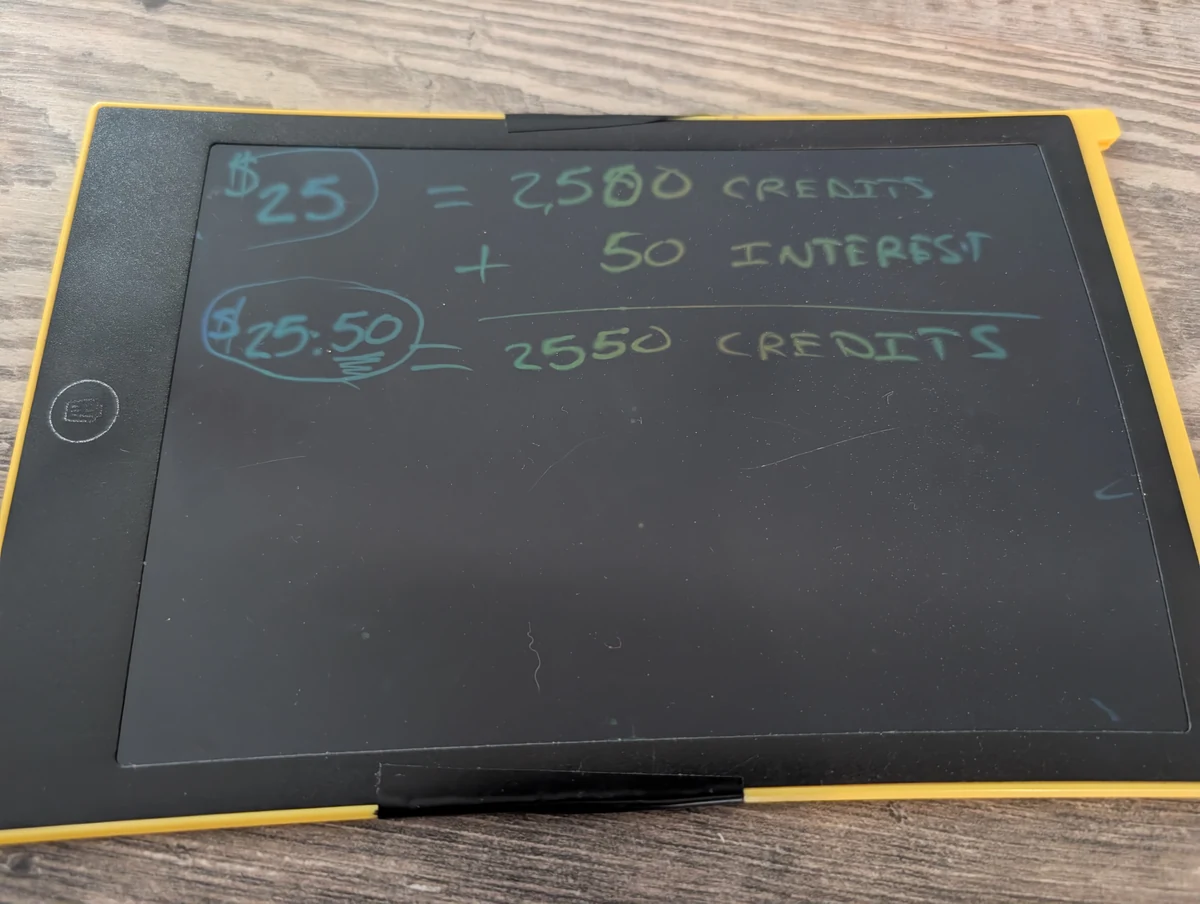
She quickly added 2,500 and 50. Moving the resulting 2,550 credits back into dollars was harder.
She could readily see that 25 credits meant twenty-five cents. But 2,550 credits becoming $25.50 required help. The smaller example made sense to her before the larger conversion did.
That difference was useful for me to notice. She was handling two questions at once: what had happened to the value, and how to express the value in another unit. Needing support with the second did not mean she had missed the first.
I helped her connect the representations. She did not need to do every step alone for the reasoning to belong to her.
Fifty Cents Became Progress Toward Something
Once she could see $25 becoming $25.50 in the example, she recognized what the additional fifty cents meant. She could see that her savings balance could grow without another task producing that particular amount.
She became excited and wanted to convert her coins into credits too, so that more of her savings could earn interest.
I asked why she wanted to maximize the interest. She connected it to the ATV. More growth would move her closer to the goal, and, with the other conditions unchanged, help her reach it sooner.
That was the moment I found most interesting. She was using interest to answer a question she already cared about. The fifty credits were no longer only an addition problem. They represented progress in a plan she was making.
Then She Added a Variable I Had Not Supplied
She wanted to keep her pennies.
Her reasoning was that pennies were becoming scarce and might be worth more later. That was her belief, not an established fact about what her coins would become worth.
I had not introduced collectibility or future coin value into the conversation. She brought that possibility into her own comparison.
What interested me was not whether her penny theory would prove correct. She was beginning to compare reasons for holding value in different forms. Cash in hand, credits toward a goal, and coins she thought might become more valuable were no longer interchangeable in her thinking.
That is a richer conversation than simply asking how much money she has.
Understanding Can Arrive Before Fluency
An earlier conversation with one of my children, when barely seven, had shown me a related pattern. The word interest did not stick. The child remembered the idea and called it “free money.”
That phrase was the child's shorthand, not a complete explanation. It told me there was a remembered concept we could return to and clarify.
My daughter's conversation showed another version of that gap. She could reason about savings growth and connect it to her goal while still needing help with a dollar conversion.
Neither moment required me to pretend the learning was complete. Vocabulary and arithmetic still mattered. But they were not the only evidence of understanding.
For this conversation, I could look at what she did with the idea: ask about ownership, recognize growth, connect it to a goal, and introduce a competing possibility herself.
Help With the Step, Leave Room for the Decision
The success was not that she wanted to save more. I would not want every money conversation to have a predetermined ending in which saving wins.
Keeping some cash available could serve a purpose for her. Spending could serve a purpose. Moving more of the value toward her ATV goal could serve a purpose too. I wanted her to have room to consider what each choice made possible and what it would leave unavailable.
My role was to make the exchange and the example understandable. Her role was to think about what those facts meant for her ATV plan.
I could check the math, explain our household terms, and ask about an assumption without deciding what she should prefer. I did not need to supply her conclusion too.
Try Starting With a Goal Your Child Already Has
This conversation began with birthday money and an ATV, not a planned lesson. Another family might begin with a much smaller goal and a notebook rather than software.
A few questions can make the choices visible:
- What are you saving for, and how much do you have now?
- Under the savings terms we have agreed on, what could the balance become?
- How much closer would that move you toward the goal?
- What would you want to keep available for spending now?
- Why does that choice make sense to you?
If your child expects something to become more valuable, ask what makes them think so and how certain they are.
If a calculation gets in the way, work through it together. If the child chooses to keep some money outside savings, that can be part of the conversation rather than a failed lesson.
For more detailed examples, our guide to teaching simple and compound interest separates those two kinds of growth. The single addition in our conversation illustrates interest; it does not demonstrate compounding.
What I Want to Keep From This Moment
FamilyRhythm gave my daughter a place to bring the value together, track her ATV goal, and consider what savings growth could do. Those things made the conversation concrete. The learning principle does not depend on using our software.
For families who prefer to begin with a story, The Patient Jar introduces the related idea through “patience money.” A story can give a child something to discuss before there is a personal decision to make. New readers can preview two pages, then create a free FamilyRhythm account for the full story; account creation also starts a 30-day trial.
What I want to keep from this exchange is the shift in my daughter's thinking. She began treating interest as one variable in a plan she cared about. I still helped with the numbers. She supplied the connection to her goal and the question about her pennies.
Teaching interest can include learning its definition. In this moment, the more useful sign was that she knew what to do with the idea when a real choice appeared.
More in the Allowance Systems series
Allowance Systems That Work for Kids: Implementation Guide
Build an allowance system that teaches value, responsibility, and financial literacy without daily arguments or tracking. Complete implementation guide with age-appropriate structures.
The Complete Guide to Allowance Systems That Teach Financial Responsibility
Comprehensive allowance roadmap. Ages 5-18. What amount when. How to structure. Teaching real money management. Not just giving kids cash. Building financial competence systematically.
How to Handle When Kids Lose or Waste Money
Respond to money mistakes with proportionate support, protected essentials, and practical repair rather than automatic non-replacement or shame.
Teaching Kids About Money Without Creating Money-Obsessed Kids
Parent fear: Teaching kids about money makes them materialistic. Reality: Kids who manage money learn its limits. Kids sheltered from money think it's magic. Balance: Financial competence without greed.
When Kids Ask for Advance on Allowance
"Can I have next week's allowance early?" Parent dilemma: Help or teach? Advance breaks the system. Why saying no teaches better than saying yes. Handling the request without guilt.
Earning, Allowance, and Gifts: Teaching Thoughtful Choices
Separate budgeting allowance, freely given gifts, household contribution, and optional earnings while protecting necessities, agreements, and earned balances.
If this kind of structure would help your household
FamilyRhythm is built for families who want to help children carry more real responsibility without managing every step.
Learn how it works